White Ceramic Plates That Make a $30 Table Look Like $300
You’ve cleaned the apartment, made the food, and then you look at the table. Three plates from one set, two from another, one rogue plate you’re pretty sure came from an old roommate. Nothing matches. Nothing looks like a decision was made. That’s the dinner party energy nobody wants.
The fix is cheaper than you think. But it requires knowing what actually separates budget ceramic that looks good from budget ceramic that looks like a fast food tray.
Why Most Budget Ceramic Plates Look Cheap — and the Three Traits That Separate the Good Ones
Cheap ceramics look cheap for a reason. Thin walls, uneven glaze, slightly warped rims. These aren’t aesthetic opinions — they’re manufacturing shortcuts that show up the moment you put food on the plate.
But some budget ceramics genuinely punch above their price. The difference comes down to three things, and you can check all three before buying.
Surface Texture Does More Work Than Color
Ultra-smooth white glaze catches light harshly and reads as plasticky. It’s the finish that costs less to produce at scale, which is why so many budget sets default to it. Higher-quality pieces — even at low price points — use matte finishes, slight surface variation, or embossed detail that scatters light naturally and reads as intentional design rather than bare manufacturing output.
The embossed white square ceramic appetizer plates at $29.95 for six use exactly this approach. The dot embossing gives each plate visual depth that a flat-glazed plate at the same price point simply can’t replicate. At 6 inches square, they’re sized correctly for appetizers, desserts, and composed small plates — not main courses, which is the right use case for this format.
Weight Tells You What Durability Looks Like
Pick up a cheap ceramic plate and a quality one. The difference is immediate. Thin-walled ceramics feel fragile, and they are fragile — corners chip on the first dishwasher cycle, glaze crazes after six months of regular use. A good budget piece has enough mass that it stays put on a table and survives the cycle without drama.
For a 6-inch plate, roughly 150–200g is your baseline. Below that, you’re accepting chip risk as a feature of the product. Above that, you’re getting actual everyday durability at a budget price point.
Corner Precision Reveals Build Quality on Square Plates
Square plates are harder to manufacture cleanly than round ones. Corners reveal mold imprecision immediately — soft edges, slightly warped angles, uneven geometry. Brands like Corelle’s Livingware line and IKEA’s 365+ series have solved this at scale for round plates. Square formats with clean corners at low prices are genuinely rare.
When a square set clears 464 reviews at 4.6 stars, that review base is answering the corner quality question for you. Buyers notice warping. A 4.6 average at that volume means the corners pass.
Square vs. Round Ceramic Plates: Which Shape Actually Works Better
This isn’t a matter of personal taste — it’s a matter of use case. The breakdown below covers where each shape performs and where it falls short.
| Factor | Square Plates | Round Plates |
|---|---|---|
| Visual style | Modern, structured, Japanese-minimal | Classic, versatile, traditional |
| Best food use | Appetizers, desserts, composed small plates | Pasta, soups, family-style mains |
| Table space | Packs tightly on rectangular tables | Better for round tables, easier stacking |
| Chip risk | Higher at corners if stored without separators | Lower overall |
| Price — 6-piece set | $25–$45 for quality | $15–$35 for comparable quality |
| Aesthetic pairing | Modern furniture, Asian-influenced decor | Farmhouse, rustic, traditional dining |
| Mixing with larger plates | Works as a styled accent or side plate | Works as a standard side plate |
| Photography | Strong geometric lines — best shot overhead | Better at slight angle on rectangular tables |
The verdict: round plates are the safer default. Square plates are the smarter buy for anyone building a modern or Asian-influenced table aesthetic, or who primarily uses smaller plates for entertaining — appetizers, desserts, cheese courses, composed bites.
If you’re mixing square appetizer plates with round dinner plates, keep the color consistent. White-on-white works. Mixing finishes or whites from different manufacturers rarely does — the tones clash subtly but noticeably under actual dining room light.
One practical note for furniture makeover projects: square plates photograph better on rectangular tables and add deliberate geometry to the composition. Round plates on rectangular tables leave visual dead space at the corners. Small detail, but it matters when the table is the focal point of the room you’ve just refinished.
What $30 Actually Buys You in Ceramic Tableware
Under $5 per plate for dishwasher-safe, microwave-safe ceramic with embossed surface detail and a 4.6-star average across 464 reviews. That’s competitive with mid-range department store pricing. Not heirloom quality. Not disposable either. These are the plates you’ll still be using in four years and not regretting.
How to Build a Cohesive Table Setting for Under $100
Most people approach table settings backwards. They buy whatever’s on sale, then try to make it look coordinated. That’s the process that produces the mismatched situation from this article’s opening. The right sequence: anchor first, build outward.
Pick Your Anchor Piece Before Anything Else
The anchor is the most visually dominant element — usually the dinner plate or the main serving piece. Everything else coordinates with it. Not matches. Coordinates. There’s a difference.
White is the easiest anchor because it pairs with anything. But white forces deliberate choices about everything else, which is actually useful. You can’t throw in a random patterned piece and call it intentional. White plates demand intentional companions.
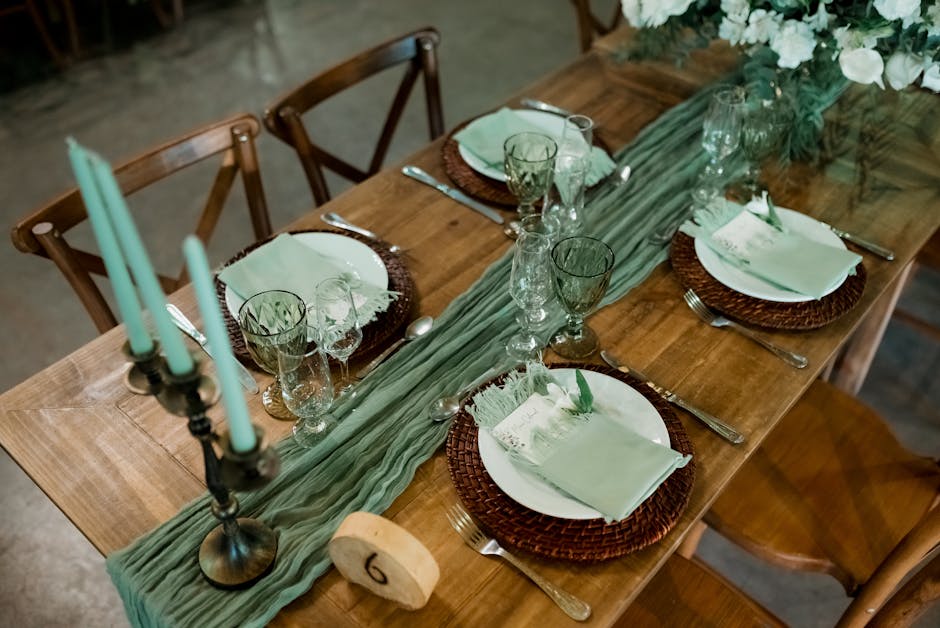
For a modern-minimal table: white square ceramic plates, wood or slate placemats, brushed matte black or silver cutlery. That combination costs under $80 total if you source placemats from IKEA and cutlery from a basic set. It looks significantly more expensive than that. The table reads as a design decision, not an assembly of whatever was available.
Two Colors Maximum — Three If One Is Neutral
This is the rule that separates tables that look designed from tables that look accumulated. Two deliberate colors. Three if one of them is white, natural wood, or black.
Ceramic accent pieces earn their place here. Baby blue ceramic soup spoons — like the long-handle flat-bottom Asian soup spoon set at $19.95 for six — add controlled color contrast against white plates without competing. Six spoons in one deliberate accent color is a design decision. Six pieces in six different colors is a collection problem disguised as variety.
The math: $29.95 for the plates, $19.95 for the spoons. Under $50 in tableware creates a complete, coordinated table setting. That’s less than one dinner out.
Tableware as the Final Layer of a Furniture Makeover
If you’ve refinished a dining table, reupholstered chairs, or painted a hutch, the tableware becomes part of how that piece reads in the room. A refinished dark walnut table with white square plates and baby blue accent ceramics tells a coherent design story — deliberate, minimal, Japanese-Scandinavian in influence. The same table with mismatched random plates makes the furniture refinishing look unfinished.
This is why tableware budgeting belongs inside a furniture makeover budget, not separate from it. The table doesn’t finish when the sanding does. It finishes when the surface is dressed intentionally.
Height Variation Without Buying More
Depth on a table comes from height variation, not quantity. A small plate slightly offset on a larger plate. A soup spoon resting across a bowl rim. A folded linen napkin adding a third texture. None of this requires additional purchases. More pieces rarely improve a table. Better arrangement almost always does. The discipline is subtracting, not adding.
Five Buyer Mistakes That Turn Budget Tableware Into Wasted Money
- Buying a size that doesn’t match the actual use case. A 6-inch plate is a small plate. It works for appetizers, desserts, snack presentations, and side portions. Using it as a main dinner plate doesn’t work — there’s simply not enough surface area for most main courses. Know what you’re purchasing before the set arrives.
- Ignoring the dishwasher reality. Hand-washing six ceramic plates after every use is a commitment most households don’t maintain long-term. If your ceramics aren’t rated dishwasher-safe, they either get damaged in the machine or stop being used entirely. Both outcomes waste money. Confirm dishwasher-safe certification before buying, not after.
- Buying mismatched whites. Warm white, cool white, pure white, and off-white look bad together under dining room light. If you’re building a coordinated table from multiple purchases, verify the whites match before combining them. This is the most common budget tableware mistake and the most completely preventable one.
- Skipping the microwave check on glazed ceramics. Some ceramic glazes contain metallic compounds that spark in microwaves. If a product page doesn’t explicitly state microwave-safe, don’t assume it. Confirm the spec before buying any glazed ceramic, especially from unfamiliar manufacturers. It’s a detail that costs nothing to check and significant inconvenience to discover after the fact.
- Blaming corner chips on plate quality instead of storage. Square ceramic plates chip at corners when stacked directly on each other without separators. Felt plate separators cost about $8 for a 24-pack and eliminate this problem entirely. Most people blame the plates, return them, buy a different set, and have the same problem again. The plates aren’t the issue. The stacking method is.
When Budget Ceramic Plates Are the Wrong Choice
This matters more than the buying advice. Knowing when not to buy something is the actual financial skill here.
Formal Entertaining Requires a Different Category
Budget ceramic works for casual hosting. It doesn’t work when the table setting is communicating occasion and care. For formal dinners, significant gatherings, or situations where the presentation carries social weight, you need a different product tier entirely. The Lenox Butterfly Meadow line runs $60–$120 for a four-piece setting. Mikasa Ciara porcelain sits in a similar range. These aren’t comparable to a $30 set — and that’s correct. They serve a different function for a different context.
High-Volume Daily Use Favors Tempered Glass-Ceramic
Corelle Livingware isn’t traditional ceramic — it’s tempered glass-ceramic that resists chipping far better than standard stoneware or earthenware at a comparable price. A Corelle 12-piece set runs $45–$65. For households with young kids, high daily plate turnover, or anyone who’s replaced chipped plates twice already, Corelle’s per-use cost over three years beats most budget ceramic alternatives. Budget stoneware is the right choice for moderate, intentional use. For daily household abuse, it’s not the economical option.
Wrong Aesthetic Makes Any Price a Waste
Embossed white square plates fit modern, minimal, and Japanese-influenced table aesthetics. They don’t fit rustic farmhouse decor, maximalist collected-over-time tables, or traditional formal settings. If your dining room has heavy distressed wood furniture, layered textiles, and warm Edison bulb lighting, you want earthy stoneware — the Hearth and Hand Magnolia line from Target or the Threshold Studio McGee collection read correctly in that context. White geometric squares don’t. Buying the wrong aesthetic for your specific room is a budget mistake regardless of what you pay per plate. Know your room before you buy the plates. The plates serve the room, not the other way around.
Practical Table Styling Questions Worth Answering Before You Buy
Can ceramic soup spoons replace standard silverware for everyday use?
For soups, ramen, pho, and Asian-style dishes — yes, completely. A ceramic spoon with a flat bottom and deep oval bowl holds liquid better than a standard dinner spoon and is easier to eat from without spillage. The flat-bottom design exists because it rests stably on a bowl rim and on the table surface, which a rounded metal spoon doesn’t do as cleanly. This isn’t a premium feature. It’s a functional difference that makes the spoon better at the specific job it’s designed for.
How do you make budget tableware look intentional in person?
Natural side lighting, not overhead fixtures. A textured surface underneath — linen, wood, slate. Remove anything plastic from the table frame. Add one organic element: a sprig of herb, a lemon wedge, a folded napkin. The plates are not the limiting factor on how considered a table looks. The arrangement and surrounding context are. A $30 set of embossed white plates arranged deliberately on a refinished walnut surface with warm side lighting reads more considered than a $120 set thrown on a cluttered table under fluorescent light.
Do 6-inch plates work as both appetizer plates and dessert plates?
Yes, and that dual function is the main reason to own a 6-piece set rather than a larger all-purpose set. A 6-inch square plate is the right size for a cheese course, a small dessert, a composed appetizer, or a charcuterie portion. It’s not a main dinner plate — it’s too small for most main courses — but within its correct use cases, it covers multiple meals and occasions without requiring a separate purchase. One plate, two functions, $5 per piece. That’s a reasonable trade.
What’s the realistic life span of budget ceramic at this price point?
With proper storage — felt separators, not bare stacking — three to five years of regular use is realistic for mid-quality budget ceramic. Without separators, corner chips on square plates start appearing in year one. That’s not a product defect. It’s a storage problem. The plates are only as durable as the conditions you keep them in. Control the storage and the life span follows.
Back to that dinner party: six matched white plates on the table, baby blue ceramic spoons resting in each bowl, nothing random in the frame. The table looks like someone made deliberate choices. Because they did. For under $50 in tableware and five minutes of arrangement, the whole room reads differently. That’s what the actual fix costs — and it works every time.
Disclaimer: The information on this page is for educational purposes only and does not constitute financial advice. Rates, terms, and eligibility requirements are subject to change. Always compare multiple lenders and consult a licensed financial advisor before borrowing.