Camping Lantern Mistakes That Leave You in the Dark
Most people buying a camping lantern fixate on one number: lumens. More lumens, better light. It sounds logical. It is also why so many campers end up with a lantern that blinds everyone within three feet and dies four hours into a weekend trip.
A camping light that actually works for real trips — multi-night camping, power outages, job sites — needs sustained output, enough battery for multiple nights, and a mounting solution beyond ‘set it on the table and hope.’ This review puts the OGERY 18000mAh Rechargeable Camping Lantern ($75.99) through its paces: a three-lamp-head unit on a 6.7-foot tripod with remote control, designed to do all of that at once.
Why Lumen Marketing Fails Real Campers
The number on the box is almost always the peak lumen output measured for roughly 30 seconds under ideal conditions. Real-world sustained output — what you actually get for four, eight, or twelve hours — can be 30 to 60 percent lower. That gap between spec and reality is where most buyers get burned.
Four bigger mistakes trip up most buyers:
- Buying for peak output instead of runtime at useful brightness. A lantern rated at 2000 lumens that sustains that level for 45 minutes before stepping down is useless on a three-night trip. What matters is how many hours you get at 400–600 lumens — enough to light a campsite or room without burning through the battery in one sitting.
- Ignoring beam pattern. Directional LED lanterns — shaped like flashlights mounted sideways — create hot spots and dark edges. For area lighting, diffused panels or omnidirectional heads spread light evenly. The shape of the light source matters as much as its intensity.
- Underestimating battery capacity needs. A two-person, three-night camping trip requires roughly 18–24 hours of usable light. Most budget lanterns carry 4000–6000mAh batteries. That covers one night at medium brightness, maybe two at low. A serious trip needs 15000mAh or more.
- No hands-free height option. A lantern sitting on a table lights the table. One hanging from a tent ceiling lights the tent. Neither lights a 20×20 campsite or a garage workspace adequately. Height matters enormously for area coverage — which is exactly why commercial work lights are always mounted on stands.
Solving all four of these simultaneously at under $100 is genuinely hard. Most manufacturers pick two and ignore the rest.
OGERY 18000mAh Lantern: Unboxing and What You Actually Get
The full kit weighs about 3.2 lbs and arrives in a tight, well-packaged box. This is not a light for backpacking — that weight number ends that conversation immediately. But for car camping, it is manageable, and the collapsed tripod at 17 inches fits in most large gear bags or SUV trunk organizers.
The three lamp heads are the size of hockey pucks, each with a magnetic base and an independent power button. The tripod uses aluminum alloy legs with locking collars — no wobble at full extension — and the heads mount to a central hub via the same magnetic connector. Each head removes entirely and works standalone, which turns out to be the most valuable feature in the kit.
| Spec | OGERY Details |
|---|---|
| Battery capacity | 18000mAh built-in lithium |
| Number of lamp heads | 3 (each detachable, independently controlled) |
| Tripod max height | 6.7 feet (2.04m) |
| Collapsed height | Approx. 17 inches |
| Brightness modes | 3 levels + SOS flashing per head |
| Color temperature | ~3000K warm white |
| Charging input | USB-C, approx. 7–8 hours full charge |
| Remote control range | ~30 feet line-of-sight |
| Water resistance | IP44 splash-resistant |
| Weight (full kit) | ~3.2 lbs |
| Price | $75.99 |
The warm 3000K color temperature is a real-world differentiator. Cool white LEDs at 5000K+ are harsh over long evening use and actively unpleasant around a campsite at night. The OGERY’s warmth is noticeably more comfortable for extended use. Build quality first impressions: better than expected at this price point. You can see the full kit specs and current listing here before reading further if you want to verify what ships in the box.
Three Days of Real Camping Use: What the OGERY Actually Delivers

Battery Life: The Real Numbers at Different Brightness Levels
With all three heads at maximum brightness, plan on roughly 4–5 hours of runtime. That is the honest math of high output versus capacity — even 18000mAh has limits when pushing three LEDs at full draw simultaneously. For a single-evening group campsite or an outdoor event, that is enough. For a multi-night solo trip running everything on full, it is a problem.
Here is where the OGERY performs well: throttle down. One head at medium brightness runs for approximately 20 hours on a full charge. Two heads at low gives 14–16 hours. For a three-night camping trip using two heads on low for evenings — roughly 6 hours per night — you get through the trip with battery remaining. That is the usage pattern the 18000mAh capacity is designed for, and it works exactly as advertised.
Compare this directly to the Goal Zero Lighthouse 600 ($89.95), which carries a 4400mAh battery with 600 lumen output. Excellent for tent lighting and compatible with Goal Zero solar panels — but one-fifth the battery capacity of the OGERY. For base camp lighting over multiple days without reliable sun charging, the OGERY wins outright on endurance.
Tripod Stability in Imperfect Conditions
On flat pavement or packed dirt with legs spread wide — rock solid. The locking collars click positive and hold under normal load. On grass, uneven terrain, or loose gravel, the story changes. At full 6.7-foot extension with all three heads attached, the center of gravity is high enough that a 15–20 mph gust will tip it. Bring the height down to the 4-foot range and stability improves substantially.
The kit does not include ground stakes for the tripod legs, which is an oversight for an outdoor product at this price. Three plastic tent stakes threaded through the leg feet fixes this problem for about $3. Worth knowing before your first windy campsite rather than discovering it at 11pm.
The collapsed 17-inch form factor fits in a gear bag, a backpack side pocket, or the trunk organizer of most SUVs. Bulkier than a single-head lantern, but meaningfully smaller than any traditional tripod work light setup you would rent or buy from a hardware store.
The Detachable Head System in Practice
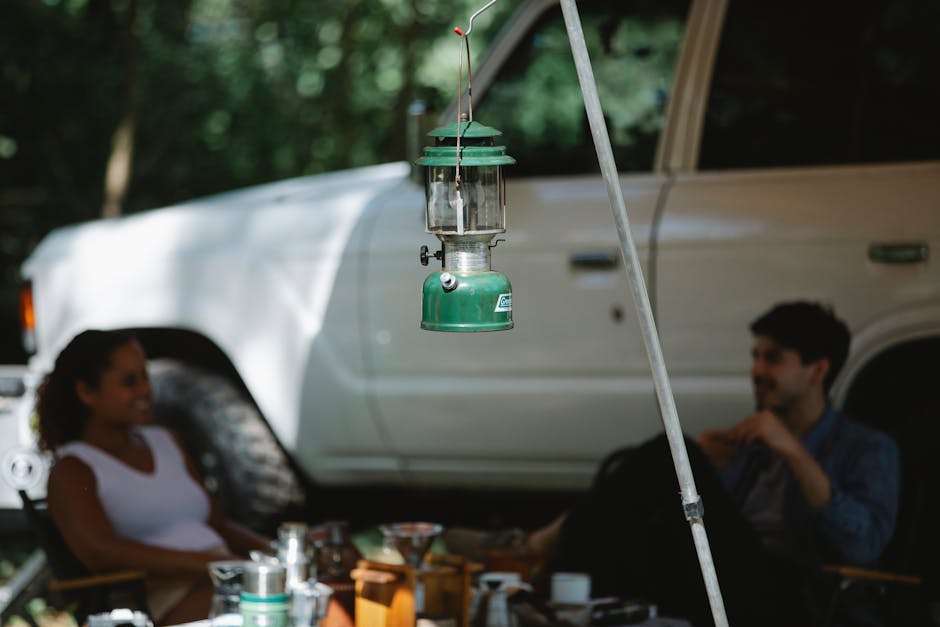
This is the feature that separates the OGERY from every other camping lantern at this price. Three lamp heads. Three independent mounting options. One on the tripod hub for overhead area coverage. One magnetically attached to a car door or metal shelf for close task lighting. One clipped to a tent loop or placed flat on a table. Three distinct light sources from one battery and one charge.
The remote handles all three heads simultaneously — power, brightness, and SOS mode. For individual head control, press the button directly on each head. Remote range is reliable to about 25 feet; past that, it occasionally misses inputs. Not a real-world problem — you are rarely more than 25 feet from your own campsite lighting.
The magnetic connection is strong enough for vertical surface mounting. A lamp head on the side of a car door will not fall from light vibration or jostling. Rough handling will dislodge it — the magnets are not designed to replace a clamp mount on a power tool — but for campsite and emergency use, they hold reliably.
OGERY vs. Goal Zero, Black Diamond, and BioLite
| Product | Price | Battery | Stand/Mount | Best Use |
|---|---|---|---|---|
| OGERY 18000mAh (3-head) | $75.99 | 18000mAh rechargeable | 6.7ft tripod included | Car camping, emergency prep, job sites |
| Goal Zero Lighthouse 600 | $89.95 | 4400mAh + solar input | Hook only | Backpacking, tent lighting |
| Black Diamond Apollo | $69.95 | 4×D batteries or USB | Hook only | Compact base camping |
| BioLite SiteLight Mini | $49.95 | 2200mAh | Stake and string | Ultralight camping |
| Craftsman LED Work Light | $59.99 | Corded (AC power) | Built-in stand | Garage and shop work |
The OGERY has no direct competition in its specific niche: rechargeable, high-capacity, tripod-mounted, multi-head camping lantern under $100. The Goal Zero Lighthouse 600 is a better choice for backpacking — lighter, solar compatible, more refined construction — but it cannot light a 20×20 campsite from height, and its battery capacity is a fraction of the OGERY’s. The Black Diamond Apollo is more packable. The BioLite SiteLight Mini weighs almost nothing. But none of them mount on a 6.7-foot stand with 18000mAh behind them.
For car campers, emergency prep households, and weekend DIY workers, the OGERY three-head kit is the most versatile option in this price range. That is a clear verdict, not a hedge. OGERY also makes the Inflatable Toddler Travel Bed with Cordless Air Pump ($75.99, 4.7/5 from 76 reviews) — worth adding to your camping setup if you travel with young children. The brand’s design philosophy is consistent: solve a specific outdoor problem well at a price that does not require justification.
The Verdict
Buy the OGERY if you car camp, prepare for power outages, or do any work in low-light conditions — it solves all three problems with one purchase. Skip it entirely if you need a light you can carry more than a quarter mile on foot. The three-head detachable system and 18000mAh battery are built for stationary use, and $75.99 is fair money for what you get. This lantern does not overpromise. It does exactly what it claims, in the conditions it was designed for.
Emergency Prep and Job Sites: Where This Light Really Earns Its Keep
How Long Does the OGERY Last During a Power Outage?
Running one lamp head at medium brightness — enough to navigate and work in a kitchen or living room — plan on 20+ hours from a full charge. That covers the vast majority of residential power outages without needing a recharge. For extended multi-day outages, the USB-C input is compatible with most 18W+ portable solar panels: the BigBlue 28W ($45), the Anker 625 Solar Panel ($70), or any power station with USB-C output like the Jackery Explorer 240.
The SOS flashing mode on each head is more useful than it appears in a product listing. A flashing light visible at distance — roadside breakdown, a flooded basement, a search scenario — is a genuine safety tool. Three independent flashing heads spread in different directions is meaningfully better than one. This makes the OGERY a legitimate permanent fixture in emergency prep kits, not just a camping accessory.
Does It Work as a DIY Garage or Attic Work Light?
Yes, and the tripod height is the reason why. At 6.7 feet with a lamp head angled downward, you get a functional overhead work light without a ladder or a permanent fixture. For attic insulation work, under-sink plumbing, or engine work in a dim garage, it covers the task area in a way a headlamp cannot and a corded light cannot reach without an extension cord.
The Craftsman LED Work Light ($59.99, corded) puts out more raw lumens — roughly 2500 compared to the OGERY’s combined ~1500 across three heads — but it requires an outlet, does not pack down, and cannot split into three independent lights covering different areas. For homeowners doing occasional evening or weekend work, the OGERY’s flexibility outperforms the Craftsman’s raw output in most real scenarios.
What Wears Out First?
The magnetic connectors on the lamp heads are the highest-wear component. Repeated attach-detach cycles over months of frequent use will gradually reduce magnetic strength. The tripod leg locks are polycarbonate and will fatigue with aggressive cycling — extended and collapsed repeatedly for transport. Neither is a dealbreaker for occasional use. For weekly use on job sites, expect the connectors to need attention after 12–18 months of regular handling.
Store the lamp heads nested together and avoid leaving the tripod legs fully extended during storage or transport — the locks hold better at mid-position. A padded gear bag protects the heads from impact. Minor habits that extend the functional life of the kit significantly.
A year ago, matching this battery capacity with tripod mounting flexibility would have cost $120 or more. The person who started shopping for a camping lantern, frustrated by all the underpowered single-night options that couldn’t light more than a picnic table, ends up with exactly what they were actually looking for.
Disclaimer: The information on this page is for educational purposes only and does not constitute financial advice. Rates, terms, and eligibility requirements are subject to change. Always compare multiple lenders and consult a licensed financial advisor before borrowing.