How to Choose and Hang Large Wall Art That Transforms a Room
A bare wall isn’t a neutral design choice — it’s a decision to leave a room half-finished. Most wall art mistakes aren’t about personal taste; they’re about sizing and placement. Get those two things right, and even a $170 canvas can make a room look deliberately designed.
What Size Wall Art Do You Actually Need?

The standard rule is that wall art should fill 57–75% of the wall space above furniture. That sounds simple until you’re staring at a product page deciding whether a 29×58in canvas will actually fit above your sofa. Go below 57% and the art floats without grounding the room. Push above 75% and it starts to crowd.
Here’s a practical sizing reference by furniture type:
| Furniture/Space | Minimum Art Width | Ideal Art Width | Common Mistake |
|---|---|---|---|
| 84″+ sectional sofa | 52 inches | 58–72 inches | Buying a 36″ piece that disappears |
| 72″ standard sofa | 44 inches | 52–60 inches | Two small frames hung side by side |
| King bed (76″ wide) | 40 inches | 48–60 inches | Vertical art above a horizontal headboard |
| Queen bed (60″ wide) | 36 inches | 40–50 inches | Art narrower than the headboard |
| Dining room (8′ wall) | 30 inches | 36–48 inches | Vertical piece on a wide horizontal wall |
| Home office side wall | 20 inches | 24–36 inches | Three small pieces cluttering the space |
Why the 29×58 Inch Format Works for Most Living Rooms
A 29×58in canvas is 4 feet 10 inches wide and 2 feet 5 inches tall. Above a standard 72-inch sofa, that provides roughly 80% visual coverage — right in the ideal range, close enough to anchor the room without crowding the wall.
The horizontal landscape proportion matters here too. When you’re viewing a living room wall from 8–12 feet away, wide beats tall. Vertical art reads better at close range — hallways, stairwells, bathrooms. In a living room, the wide format holds visual weight at the distance you actually use the room from. Think of it as the difference between a banner and a small sign: one commands the space, the other decorates a corner of it.
Single Large Canvas vs. Gallery Wall
For a primary sofa wall, one large piece almost always wins. Gallery walls require consistent framing, precise spacing, and careful measurement. Get the spacing slightly wrong and the whole arrangement reads as chaotic. Change the sofa and half the arrangement stops working.
A single 58-inch canvas goes up in 20 minutes and makes an unambiguous statement. It also functions as a design anchor — once you have a dominant piece, throw pillows, rugs, and accent objects all start to make compositional sense in relation to the art. Gallery walls earn their place in stairwells, long hallways, and bedroom feature walls. For living rooms, one statement piece is almost always the smarter call.
How to Read a Room Before Choosing Art Style
Most buying regrets happen because people skip this step. They find something they like online, buy it, and realize it argues with everything else in the room. Spending 20 minutes analyzing the space first saves a $170 return shipping problem.
Identify Your Three Dominant Room Colors First
Look at your sofa, rug, and curtains. These three elements define roughly 80% of the room’s color story. Write them down before browsing.
Warm neutral palette — beige sofa, cream-and-terracotta rug, white curtains: you want art that picks up one of those tones or introduces a single carefully chosen contrast. Dusty blue, muted sage, or faded ochre work. One accent color maximum. More than that and the art starts competing instead of completing.
Cool neutral palette — charcoal sofa, gray hardwood, white walls: gray and black abstract art sits native to that space. But one warm contrast in the art (copper, burnt orange, deep burgundy) can activate a room that reads as cold without it. The key is keeping it to one warm hue, not a full palette reversal.
Already-colorful rooms — patterned rug, bold sofa, printed pillows: go simpler with the art. A minimally colored canvas gives the eye somewhere to rest. Stacking pattern on pattern reads as visual noise, not design intention.
Match Art Weight to Furniture Weight
Heavy furniture needs heavy art. A chunky leather sectional, a thick-legged coffee table, a dark stained sideboard — these pieces carry visual mass. Art above them should match that mass, or it disappears against the furniture’s presence.
A wide-format canvas with a 1.5–2 inch frame depth has three-dimensional presence that a flat poster print simply can’t replicate. The shadow line the frame creates against the wall adds definition at distance. A flat, lightweight print above a substantial piece of furniture reads as an afterthought, regardless of the image quality.
Light furniture — Scandinavian oak legs, linen upholstery, open shelving — pairs better with art that has breathing room. More white space in the composition, lighter palette, thinner or frameless presentation. The IKEA RIBBA and HOVSTA frames ($15–$30) work well in lighter room aesthetics when you’re building a smaller grouping rather than committing to one dominant piece.
Natural Light Changes How Art Looks on Your Wall
South-facing rooms get strong, warm light most of the day. Colors appear more saturated, so bold art can read as overwhelming by midday. If your room gets direct afternoon sun, lean toward cooler palettes or compositions with more white space.
North-facing rooms get softer, cooler, flatter light. Heavy dark art absorbs what little light there is and can make the room feel dim. In north-facing living rooms, warm and colorful abstract art serves a functional purpose — it introduces warmth the light doesn’t provide.
Artificial lighting compounds this. Warm LED bulbs (2700K) push everything slightly yellow. Blues and purples shift warmer under warm-toned light. If you’re buying a canvas with significant blue tones and your room runs on warm bulbs, check how the art looks under similar light before finalizing the purchase.
The Rule That Fixes Most Bare Walls
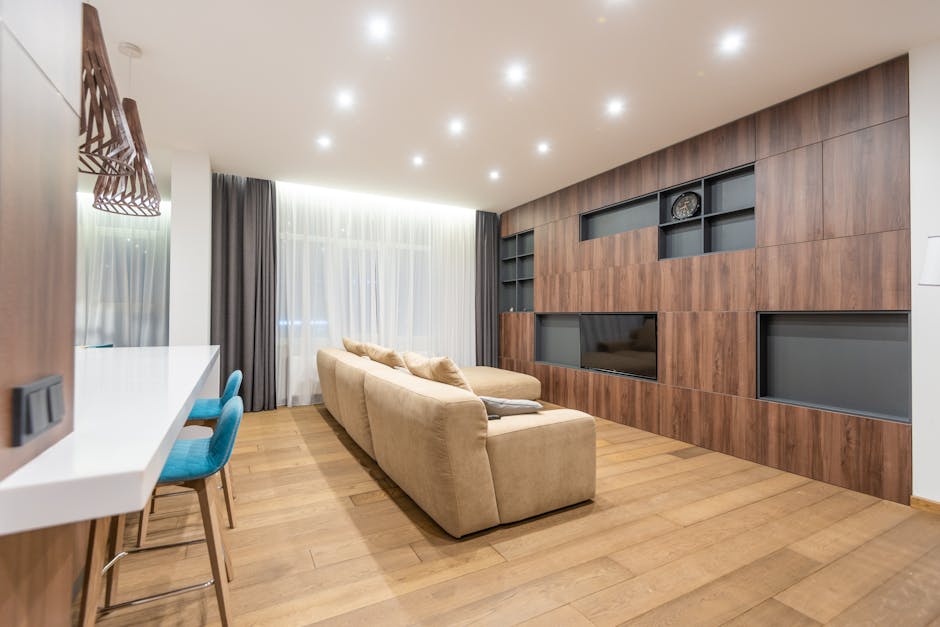
Buy bigger than feels comfortable. The piece that looks slightly too large in the store is almost always the right size on the wall. Your brain compensates for surrounding blank space in a showroom — designers call this the sizing paradox — so art that seems bold in a gallery reads as timid once it’s home, surrounded by furniture and architecture.
When you’re torn between two sizes, pick the larger one.
How to Hang a Large Canvas Without Damaging Your Walls
A 29×58in framed canvas typically weighs 10–15 lbs. That’s manageable, but one bad hang leaves large holes and art that slowly rotates over months. Here’s the process that works every time, including in rentals where wall damage matters.
Step 1 — Find Your Center Point Before Touching a Nail
Center large art on the furniture below it, not the room. Find the visual midpoint of your sofa by measuring it — not eyeballing it. Then measure up from that center point: eye level when seated is 57–60 inches from the floor, and that’s where the vertical center of the art should land.
If your sofa’s visual center sits at 36 inches from the left wall, mark a vertical line at 36 inches. If seated eye level is 57 inches from the floor, mark a horizontal line there. That intersection is where the canvas center hangs. Everything is built from that calculation.
One useful technique: cut a paper template the exact size of the canvas and tape it to the wall before drilling anything. Live with it for a day. It sounds excessive, but it eliminates almost all “I should have moved it two inches higher” moments.
Step 2 — Use Two Anchor Points for Anything Over 30 Inches Wide
A single hook creates a pendulum — the canvas will slowly rotate until it hangs crooked. Two anchor points spaced 16–24 inches apart eliminate this entirely.
For drywall without stud access, use self-drilling toggle anchors. The Toggler SNAP TOGGLE (Home Depot, ~$8 for a 6-pack) works in standard 3/8″–1/2″ drywall and holds up to 238 lbs per anchor. That’s extreme overkill for a 15-lb canvas, which is exactly what you want. Cobra and Hillman make nearly identical alternatives at the same price point.
Measure the distance between the hanging hardware on the back of the frame. Transfer that exact measurement to the wall with a pencil and a 24-inch level. Mark both points, install both anchors, hang the piece, then check level across the top edge.
Step 3 — Check From a Distance Before Finalizing
After hanging, walk back 10–12 feet and look at the piece. Small adjustments — one inch higher, two inches left — are much easier to see from distance than when you’re standing directly in front of it. Make corrections before you call it done.
Also check from two positions: seated on the sofa and standing. Art that reads perfectly from standing height is often slightly too high when you’re seated. In a living room, the seated perspective is primary — that’s where people actually spend time with the room.
Abstract vs. Realistic Art — The Honest Call
Abstract art is the better long-term choice for most modern and transitional living rooms. Not because realistic art is inferior — it isn’t — but because abstract art ages better through room changes.
Realistic landscapes, nature photography, and figurative prints are tied to a specific mood and color range. Repaint from warm white to cool gray, swap the sofa, or replace the rug, and that specific piece may stop working with the room. Good abstract art — particularly neutral or color-driven abstract — moves with the room because it doesn’t lock the space into one interpretive frame.
When Colorful Abstract Art Is the Right Pick
Warm-toned colorful abstract art works best in rooms with a neutral base that need energy injected. White walls, beige upholstery, light hardwood floors — the room is calm but flat. Color in the art becomes the activating element, and the right piece does this without forcing a decorating theme on the room.
The Pogusmavi 29×58in framed abstract canvas ($169.90, 4.6/5 from 748 reviews) handles this well. At 58 inches across, it covers a standard sofa wall with real authority. The colorful abstract composition adds movement and warmth without specifying a mood — it doesn’t force a “beach house” or “maximalist” story onto the room. The float-mount frame adds shadow depth that flat gallery-wrapped canvas pieces can’t replicate at distance.
When Gray and Black Tones Make More Sense
Cool, monochromatic rooms need art that stays in the same tonal family. Placing warm-toned colorful art in a room with gray upholstery, cool metal hardware, and silver accents creates contrast that reads as a mistake rather than a design decision.
For those spaces, the large abstract canvas in gray and black tones ($169.90, same 29×58in format) integrates naturally. The monochromatic palette works especially well in home offices and bedrooms where the room calls for calm over energy. Both pieces share the same 4.6-star rating and price point — the decision comes down entirely to your room’s existing color story.
Questions to Answer Before You Buy
Should Canvas Art Be Framed or Gallery-Wrapped?
Gallery-wrapped canvas has the image wrapping around the stretcher bars with no frame border. It works in clean, contemporary spaces where frames feel heavy or fussy. The edge of the canvas becomes part of the composition — before buying, confirm the listing shows what those edges look like, because some manufacturers wrap the image and others wrap a solid color border.
Framed canvas adds definition and visual weight. It reads better in rooms with traditional architectural details (crown molding, panel doors, ornate hardware) and in any space where you want the art to feel considered and formal. For most living rooms with mixed-style furniture, a simple frame is the lower-risk choice — it signals intention that frameless canvas sometimes lacks from a distance.
What Should You Expect to Pay for 58-Inch Canvas Art?
Under $80: thinner canvas stock, fewer frame options, variable print resolution. Fine for a temporary space or a rental apartment where the piece isn’t a long-term investment.
$100–$200: where consistent quality starts. Better canvas weight, more reliable color accuracy, actual frame hardware included. The $169.90 price point for the Pogusmavi and the gray-and-black alternative both land here. At that price for a piece covering nearly five feet of sofa wall, the per-inch cost is reasonable — and both have 748 reviews behind them, which reduces the guesswork.
$300–$2,000+: original or semi-original art from galleries, Etsy artists, or local painters. Worth it for a forever home or a room you’re investing in heavily. The trade-off: you’re buying something unique, but return options are limited if it doesn’t work in the space.
Can You Hang 58-Inch Art Without Finding a Stud?
Yes. Drywall toggle anchors rated at 50+ lbs per anchor (Toggler, Cobra, Hillman) are more than sufficient for a framed canvas weighing 10–15 lbs. Two anchors spaced 16–24 inches apart, leveled carefully, will hold without issue. The Pogusmavi framed canvas includes mounting hardware — confirm that before buying extra supplies, because a hardware store run after unboxing a 58-inch frame is an avoidable frustration.
The single most important factor in large wall art isn’t the color or the subject — it’s the size, and committing to a piece that’s bigger than feels instinctively safe is almost always the right decision.
Disclaimer: The information on this page is for educational purposes only and does not constitute financial advice. Rates, terms, and eligibility requirements are subject to change. Always compare multiple lenders and consult a licensed financial advisor before borrowing.