Here is the misconception that derails most bathroom renovations before a single tile is laid: expensive materials automatically mean a durable result. They do not. A $15-per-square-foot porcelain tile installed over the wrong substrate will crack within two years. A $4-per-square-foot ceramic tile set on properly waterproofed cement board lasts 20. Material selection is about matching properties to conditions — not chasing price tags or showroom aesthetics.
What follows is a data-driven breakdown of bathroom renovation materials by moisture ratings, PEI scores, substrate requirements, and where budget cuts cost you twice.
Bathroom Flooring: A Side-by-Side Material Comparison
Before picking a floor, understand one number: the PEI rating (Porcelain Enamel Institute). It rates tile hardness from 0 to 5. Bathroom floors need PEI 3 at minimum. Shower floors need PEI 4 or higher alongside a wet coefficient of friction (COF) of at least 0.42. These are not suggestions — they are the industry standards that separate tiles that hold up from tiles that become a liability.
| Material | Avg Cost/sq ft | Moisture Resistance | Lifespan | DIY Difficulty |
|---|---|---|---|---|
| Porcelain Tile | $3–$15 | Excellent (<0.5% absorption) | 25–50 years | Moderate |
| Ceramic Tile | $1–$8 | Good (3–7% absorption) | 20–30 years | Easy–Moderate |
| Natural Stone (Marble/Slate) | $5–$40 | Poor without sealing (marble absorbs up to 20%) | 30+ years with maintenance | Hard |
| Luxury Vinyl Plank (LVP) | $2–$7 | Excellent (100% waterproof core) | 15–25 years | Easy |
| Engineered Hardwood | $4–$10 | Poor in high-moisture zones | 10–20 years | Moderate |
| Sheet Vinyl | $1–$5 | Good (seams are the weak point) | 10–15 years | Easy |
Porcelain vs. ceramic: where the money actually goes
For most primary bathrooms, porcelain wins on longevity. Daltile’s Restore collection (about $3.50/sq ft) and MSI’s Villa Lagoon series ($4–6/sq ft) both offer mid-tier porcelain that consistently outperforms premium ceramics in moisture cycling tests. The absorption rate difference is the reason: ceramic’s 3–7% absorption means it can swell and micro-crack in high-humidity bathrooms over time. Porcelain’s sub-0.5% absorption is functionally waterproof. For a master bath with daily shower traffic, the $2/sq ft premium over ceramic pays back in reduced maintenance.
When LVP beats tile outright
Renovating a rental, flipping a property, or working with an uneven subfloor? Lifeproof Sterling Oak LVP (approximately $3.50/sq ft at Home Depot) is the smarter material. It installs over minor subfloor imperfections that would telegraph cracks into tile, handles humidity without issue, and costs significantly less in labor because it floats rather than sets. The honest tradeoff: LVP can be damaged by standing water infiltrating seams over years of use. It is not a shower floor material under any circumstances, and it will not impress buyers the way tile does at resale.
Grout Fails Before Tile Does
Standard sanded grout, sealed once a year, will always underperform modern alternatives. The grout joints in a tile installation are the single most common failure point in bathrooms — they harbor mold, absorb moisture, and crack before the tile does. MAPEI Flexcolor CQ (approximately $30 per bag, covering about 40 sq ft at 1/8-inch joints) is a pre-mixed, stain-resistant, crack-resistant grout that eliminates the majority of standard grout failures. For showers specifically, Laticrete SpectraLOCK Pro epoxy grout ($45–60 per kit) is essentially impermeable and requires no sealing. The cost difference over traditional grout is about $30–50 total for a standard bathroom. Spending it here is the highest-return upgrade in the entire material budget.
Why Substrate Choice Determines Whether Your Tile Survives
This is where bathrooms fail — and where most renovation guides skip to the pretty surfaces. The substrate is the layer between your subfloor and your tile. It is the most consequential decision in a tile bathroom renovation, and it gets the least attention in budget planning.
The core rule: wood-based substrates fail in wet zones. Regular drywall swells and disintegrates. Greenboard (moisture-resistant drywall) resists casual splash, not sustained shower spray. The Tile Council of North America explicitly prohibits greenboard in shower applications. It still shows up constantly in renovations — and it is why tiles pop off shower walls within three to five years in houses where someone cut this corner.
Cement board: the baseline requirement
James Hardie HardieBacker (1/2 inch, about $14 per sheet at Lowe’s) and USG Durock (1/2 inch, about $13 per sheet) are the two dominant products. Both work for walls and floors. Both require a separate waterproofing membrane in wet zones — cement board is dimensionally stable when wet, not waterproof. Screw spacing matters: 6 inches on edges, 8 inches in the field, using corrosion-resistant screws only. Missing this specification causes fastener corrosion that loosens boards over time.
Uncoupling membranes for tile floors
The Schluter DITRA uncoupling membrane (approximately $3.20/sq ft) is the most important $100 to $150 you will spend on a tile bathroom floor. It decouples the tile layer from the subfloor, absorbing the stress caused by seasonal wood movement beneath. Homes with DITRA floors do not get cracked grout lines at year five. Homes without it frequently do — especially in climates with significant temperature swings between seasons. Installation is straightforward: unmodified thinset below the membrane, polymer-modified thinset above it, and the tile sets normally on top. It adds about $0.50/sq ft to material cost and is worth every dollar.
Foam board systems for shower walls
Wedi Board (approximately $45–65 per panel) and Schluter Kerdi-Board ($35–50/panel) are pre-waterproofed foam-core boards designed specifically for shower walls. They eliminate the separate waterproofing step required with cement board, reduce wall weight, and cut installation time. For a full shower surround, the cost difference versus cement board plus a liquid-applied membrane is roughly a wash at around $300–450 total either way. Where foam board systems earn their cost: for first-time renovators who might apply liquid waterproofing inconsistently, the pre-manufactured waterproof core removes a significant failure variable from the equation.
Cabinet and Vanity Materials That Survive Bathroom Humidity
Bathroom cabinets operate in a harder environment than kitchen cabinets: smaller enclosed spaces, consistent high humidity from daily showers, and more temperature cycling. These four categories define the market, and the price gaps between them are not arbitrary.
- Solid wood: Expect $400–1,200 for a 36-inch vanity in solid maple or oak from manufacturers like Strasser Woodenworks or KraftMaid. Solid wood handles humidity better than its reputation suggests — the failure mode is usually an inadequate finish coating, not the wood itself. Catalyzed lacquer or conversion varnish finishes outlast water-based polyurethane in humid bathrooms by years.
- Plywood core with hardwood veneer: The best value for most bathroom renovations. Mid-range plywood-core cabinets from American Woodmark or Wellborn Cabinet (typically $350–700 for a 36-inch vanity) hold edge profiles better than particleboard and resist delamination reliably over 10-plus years. The IKEA GODMORGON line ($350–450 with legs) competes at entry level with a melamine-coated particleboard carcass — acceptable for lower-traffic bathrooms but not the same construction quality.
- MDF (Medium-Density Fiberboard): Common in builder-grade vanities under $300. MDF paints cleanly and is dimensionally stable in dry conditions. The problem: it swells and disintegrates from the bottom when exposed to standing water. A vanity with an MDF carcass and no base protection will fail under a slow drain leak within 12 to 18 months. Acceptable for a dry powder room, not for primary bathrooms with daily shower use nearby.
- Thermofoil over MDF: Looks sharp in the showroom. In practice, the vinyl wrap peels and bubbles when exposed to sustained moisture or heat sources. It is the most frequently reported cabinet failure in bathroom renovation forums. Skip it for any cabinet within 4 feet of a shower or above a steam source.
Shower Wall Materials: Common Questions Answered
Does large-format tile always outperform smaller tile?
Large-format tiles (anything over 15 by 15 inches) have fewer grout lines, which translates to less maintenance and a cleaner visual. The catch is substrate flatness: they require a surface within 1/8 inch over 10 feet per ANSI A108.02. Most walls are not that flat without significant prep work. Rectified porcelain from Emser Tile or MSI in 24 by 48-inch format ($4–8/sq ft) is excellent in the hands of an experienced installer. For DIY renovators, 12 by 24 is a more forgiving format that still minimizes grout lines without demanding near-perfect walls.
Is solid surface worth choosing over tile?
Solid surface panels — Swanstone surrounds, Corian shower wall panels, or cultured marble — are seamless and nearly maintenance-free. A full Swanstone MSMK-96-3 three-panel shower surround kit runs $400–600 and installs in a single day. The honest tradeoffs: repairs are harder, the aesthetic reads as builder-grade in most markets, and resale buyers consistently prefer tile. Solid surface makes objective sense for rental properties, secondary bathrooms, or anyone who has dealt with ongoing grout maintenance and decided it is not worth the upkeep.
Can peel-and-stick tile work in a shower?
No. Peel-and-stick tiles fail at seams when exposed to steam and consistent water. They hold up on a dry backsplash or accent wall. In a shower surround, they are a renovation that gets redone within 18 months. The adhesive is not rated for wet zone applications, and the seams between panels are an open path for water infiltration into the substrate behind them.
The Waterproofing Shortcut That Costs $3,000 to Fix
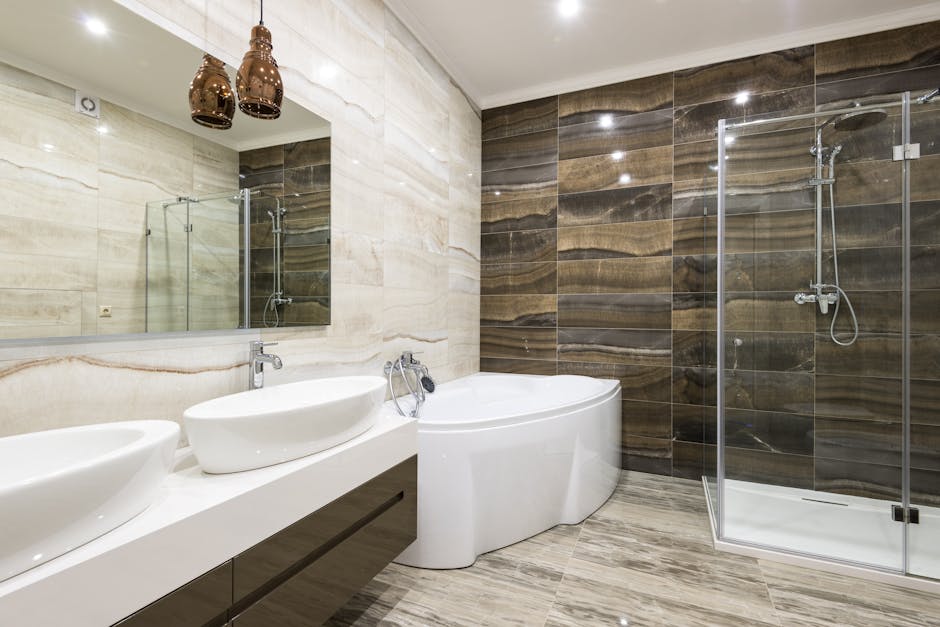
Skipping proper shower pan waterproofing is the single most expensive material mistake in bathroom renovation. Not aesthetically — structurally.
A failed shower pan leaks water into the subfloor. Subfloor rot alone costs $800–1,500 to remediate. Add retiling the shower, reinstalling the base, and any mold remediation, and the repair bill runs $2,500–4,000. A proper waterproofing membrane costs $60–150 in materials and two hours of application time.
The standard method: apply Laticrete Hydro Ban ($60–80/gallon, covering 40–50 sq ft at two coats) or Schluter Kerdi sheet membrane to all shower floor surfaces and wall surfaces, extending at least 6 inches up from any horizontal surface. Corners, drain collars, and niche edges get extra attention — these are where liquid membranes are most often applied too thin. Allow a full 24-hour cure before tiling.
The second most common material mistake: using wall tile on shower floors. Wall tiles carry higher absorption rates, lower COF ratings, and are not engineered for load-bearing foot traffic. Daltile Rittenhouse Square wall tiles are popular — and they crack on shower floors within months when used there because they are not rated for that application. The label tells you . If it says wall tile, keep it on walls.
Real Cost Ranges for a Full Bathroom Material Budget
These ranges reflect 2026 national averages for a 50–70 sq ft primary bathroom. Labor is excluded — materials only.
| Category | Budget Tier | Mid Tier | Premium Tier |
|---|---|---|---|
| Floor Tile (materials only) | $1–3/sq ft ceramic | $3–8/sq ft porcelain | $8–25/sq ft natural stone |
| Shower Wall Tile | $2–5/sq ft ceramic | $4–10/sq ft porcelain | $10–40/sq ft stone or glass |
| Substrate + Waterproofing | $120–200 | $200–400 | $400–800 (foam board systems) |
| Vanity (36 inch) | $150–350 (MDF/thermofoil) | $350–700 (plywood core) | $700–2,000+ (solid wood) |
| Toilet | $100–200 (American Standard Cadet 3) | $250–500 (TOTO Drake II) | $600–2,000+ (TOTO Neorest) |
| Faucet and Fixtures Set | $80–150 (Moen Chateau series) | $200–400 (Kohler Artifacts) | $500–1,500+ (Brizo Litze) |
| Total Materials (50 sq ft bath) | $800–1,500 | $2,000–4,000 | $5,000–12,000+ |
The most defensible allocation strategy: spend at mid-tier on substrate and waterproofing without compromise, choose budget-tier tile in a clean format, and redirect the savings toward fixtures and the vanity. A Schluter DITRA floor with $3/sq ft porcelain outperforms a bare cement board floor with $15/sq ft marble every time — because the substrate, not the surface, is what fails first.
That opening misconception — that expensive materials guarantee good outcomes — loses its grip once you see where renovations actually break down. Substrate failures, moisture infiltration, and wrong material for the application account for the overwhelming majority of bathroom renovation callbacks. Get those fundamentals right, and even a budget-tier material list produces a bathroom that holds up for 20 years.